

You're probably not getting interviews for one of three reasons: you're applying to jobs you don't clearly fit, your resume doesn't show the fit you have, or your application arrives too late or through the most crowded channel. Work out which stage is failing first, because each one has a different fix.
Why am I not getting interviews?
Because something breaks at one of three stages before a person decides to call you: targeting (which jobs you pick), your resume (whether it shows you fit), or reach (how and when your application gets in front of someone). The 12 reasons below sit in those three groups.
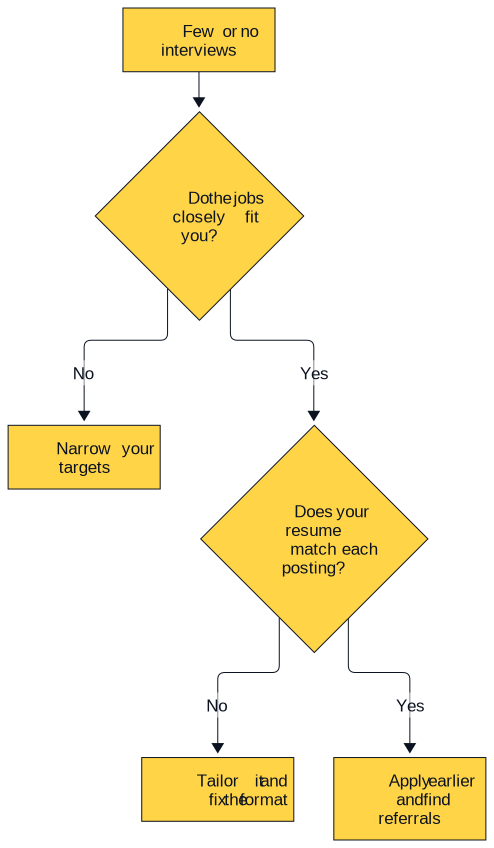
Find your stage before you change anything. A rewritten resume won't help if the jobs are a poor fit, and better targets won't help if your resume hides the match.
The pages that rank for this question, such as Indeed's list of 14 reasons, mix these stages together, and some add interview problems like outfit or nerves. Those can't stop a first invitation, so this guide leaves them out.
Is it me or the job market?
Often it's partly both. The market sets how hard the search is, and your targeting, resume and timing decide how you do within it.
The latest Job Openings and Labor Turnover Survey from the U.S. Bureau of Labor Statistics, released November 3, 2026, counted 7.5 million job openings in September 2026 and 5.4 million hires. The hires rate was 3.4 percent.
Source: U.S. Bureau of Labor Statistics, Job Openings and Labor Turnover Survey
See the data as a table
| Value | |
|---|---|
| Job openings | 7.5 million |
| Hires | 5.4 million |
| Quits | 3.4 million |
| Layoffs and discharges | 1.6 million |
Those numbers show employers are hiring millions of people a month. They don't tell you how many people apply to each job, and no official source counts that.
Things you can't control
Some silences have nothing to do with you. Career.io's guide lists several:
- The role was put on hold or its budget was cut.
- An internal candidate or a referral got it.
- The team changed what it needed after posting.
You'll never see these from outside, which is why one quiet week isn't a signal. Judge your search by the pattern across many applications.
Are you applying to jobs you don't fit?
This is the most common cause, and the first one to check. If a recruiter can't see in a few seconds why you fit, they move on.
1. The jobs are a stretch
You meet the job title but not the core requirements: the years of experience, the license, the main tool. An advisor at the University of Florida's career center suggests applying where you meet at least 75 percent of the listed qualifications.
Fix: treat that as a rule of thumb, not a law. Make sure you meet the first few requirements and anything marked required, and that your resume shows each one. For which gaps are worth applying with and which aren't, see should you apply if you don't meet every requirement.
2. You're overqualified, or aiming below your level
Employers may assume you'll want more pay or leave soon. This hits experienced people who move down a level and career changers starting over.
Fix: explain the move in one or two lines in a cover letter tailored to the job, and trim senior details that don't serve the role.
3. Your targets are too scattered
Applying to five different kinds of job means five different resumes, and in practice you send one generic version to all of them.
Fix: pick one or two job titles that fit your experience and build your search around them. Add a third only once those are getting replies.
Is your resume the problem?
If you're applying to jobs you clearly fit and still hear nothing, your resume is the next suspect. Usually it does show the right experience, but not in the words or order the recruiter is looking for.
4. One generic resume for every job
A general resume describes your work in your own terms. The recruiter is scanning for theirs, and the posting tells you what those are.
Fix: tailor the top third of your resume to each posting. The guide to tailoring your resume to a job description walks through it in steps.
5. The posting's keywords are missing
Recruiters search their applicant tracking system for skills and titles. If the posting says "Microsoft Excel" and your resume says "spreadsheets", that search may miss you.
Fix: list the tools, skills and titles the posting names and use its wording where it's true for you. Finding keywords in a job description shows how. If the titles you search for only bring back the job you already have, find jobs from the skills on your resume.
6. The format doesn't read cleanly
Columns, text boxes, skill bars and headers can scramble or drop your text when software reads the file. You aren't automatically rejected, but your record comes out incomplete.
Fix: use one column, standard headings and a text-based PDF or Word file. The ATS-friendly resume guide has a copyable template.
7. Typos, and duties instead of results
A misspelled company name or a broken sentence makes a busy reader stop. Bullets that only say "responsible for" leave them guessing what you achieved.
Fix: read your resume out loud before each upload, and rewrite each bullet as action, what you did it with, and the result or scale, using facts you can back up. The guide to writing resume bullet points shows how, with examples. If your job didn't come with metrics, quantifying your resume without numbers covers other ways to show scale. To find these problems quickly, the free resume score checker flags weak verbs, bullets with no results and formatting an ATS may misread, and quotes the exact line to fix.
Are you applying too late or in the wrong places?
If your targets and resume are solid, look at how your application gets in. The busiest route is a job board application sent days after the posting went up.
8. You apply after the first wave
Many recruiters start reviewing as applications arrive, and some stop once they have enough good candidates.
Fix: set alerts for your one or two job titles, and apply within a day or two of a posting going up when the job fits well.
9. You only apply online
UF's career center names "only applying for jobs online" as one of its five reasons students don't get interviews. A referral or a direct note puts your name in front of a person, not just in a database.
Fix: for each job you really want, look for one person to contact: a former coworker, an alum, or the hiring manager. Ask a specific question first, then ask whether they'd refer you.
10. Location doesn't line up
A job two states away, or a remote job limited to certain states, may screen you out on location before anyone reads your experience.
Fix: check the posting's location rules, put your city and state on your resume, and say plainly in a cover letter if you're relocating and when.
Could gaps, your online profile or the application itself hold you back?
Less often, but yes. These rarely cause a total drought on their own, and they're quick to check.
11. An unexplained gap
A gap with no context leaves a reader to guess. A one-line explanation is usually enough.
Fix: add a short line where the gap falls, such as "Family caregiving, 2024–2025", or explain it in a cover letter. Rolefitly doesn't score employment gaps, but some recruiters still ask about them.
12. Your profile or application doesn't match your resume
Different dates on LinkedIn, a missing answer on the application form, or a skipped instruction such as "include a portfolio link" all look careless.
Fix: make your LinkedIn dates and titles match your resume, read the whole posting for instructions, and check every field the application form filled in from your upload. Indeed's guide also notes that employers may look at your social media, so check what's public under your name.
What does fixing a resume for one job look like?
Here's one posting, one bullet before and after, and what changed. The "after" uses only facts that are already in the "before".
The posting
This job description is an illustration, written for this example. It isn't a real posting.
Operations Coordinator, regional distribution company, Columbus, OH
You will: coordinate delivery schedules with drivers and warehouse staff. Track inventory in Microsoft Excel. Work with vendors to resolve late or short shipments. Report weekly metrics to the operations manager.
The bullet before
The candidate is moving from retail into operations. Their resume has one long bullet under their store job:
- Responsible for the stockroom. Did the weekly inventory count in a
  spreadsheet, made the schedule for delivery days and called suppliers
  when deliveries were late.
All the relevant work is there. But it opens with "responsible for", hides the schedule in the middle, and uses "spreadsheet" and "suppliers" where the posting says "Microsoft Excel" and "vendors".
The bullets after
- Coordinated the store's delivery-day schedule and contacted vendors to
  resolve late deliveries
- Tracked stockroom inventory with a weekly count in Microsoft Excel
Each fact comes from the original bullet. "Suppliers" became "vendors", which means the same thing. "Spreadsheet" became "Microsoft Excel" only because the candidate used Excel, which you should confirm before you write it.
What changed
This comparison is an illustration, worked out by hand for this example. It isn't output from running a product.
| Posting asks for | Before | After |
|---|---|---|
| Coordinate delivery schedules | Buried mid-bullet | First words of a bullet |
| Track inventory in Microsoft Excel | Partly ("a spreadsheet") | Yes, in the posting's words |
| Work with vendors | Partly ("called suppliers") | Yes, "contacted vendors" |
| Report weekly metrics | No | Still no |
Three of the four requirements now show clearly. The fourth stays unmet, because the candidate never did it, and tailoring can't add it. If that requirement is central to the job, it's a sign to pick a closer target.
This is the comparison Rolefitly shows for each match: what the employer asked for, next to the resume line that shows it, or a plain note that nothing does.
A self-check to find your reason
Copy this table and fill in the last column for your last 10 applications. The first stage where you answer "no" is where to start.
| Stage | Question | Yes or no |
|---|---|---|
| Targeting | Do I meet the core requirements of most jobs I apply to? | |
| Targeting | Am I applying to only one or two job titles? | |
| Targeting | Is my level right, neither a big stretch nor far below? | |
| Resume | Did I change my resume for each posting? | |
| Resume | Does my resume use the posting's words for its main tools and skills? | |
| Resume | Does the text paste cleanly into a plain text editor? | |
| Resume | Has someone else proofread it in the last month? | |
| Reach | Did I apply within a day or two of the posting going up? | |
| Reach | Did I contact at least one person at the companies I most wanted? | |
| Reach | Does my location fit the posting's rules? | |
| Details | Do my LinkedIn dates and titles match my resume? | |
| Details | Did I follow every instruction in the posting? |
What job search mistakes cost you interviews?
These are the habits that keep a search stuck, each with its fix.
- Sending more applications when replies are zero. More of the same gives the same result. Fix: pause, run the self-check above, and change one stage at a time.
- Rewriting everything after a quiet week. You can't tell what worked. Fix: give each change two or three weeks and a fair number of well-matched applications before judging it.
- Adding skills you don't have. It may get a call, and then fails in the interview or the reference check. Fix: describe only work you did, and treat real gaps as a sign to choose closer targets.
- Using one resume for different job titles. It ends up matching none of them well. Fix: keep a short version for each of your one or two target titles, and tailor from there.
- Applying only through job boards. It's the most crowded route. Fix: apply on the employer's own careers site where you can, and pair your best applications with a personal contact.
- Ignoring the application form. A wrong date or empty field the site filled in from your upload looks careless. Fix: check every field before you submit.
- Measuring your search by applications sent. Volume says nothing about fit. Fix: track replies per well-matched application instead, and set a weekly pace you can tailor for. See how many jobs to apply to per day.
How do you start getting interviews this week?
Pick one stage and fix it properly, rather than nudging everything at once.
- Narrow your targets to one or two job titles you clearly fit, and find 10 current openings for them.
- Tailor your resume to each one, using the posting's words for the work you've really done.
- Apply early, on the employer's own site where you can, and contact one person at each company you most want.
Then track replies for a few weeks before you change anything else.