To quantify your resume without numbers like revenue or percentages, measure something else: how many people or things you handled, how often, how long, for whom, and what was different before and after. When you don't know the exact figure, estimate from a sample you can explain. When nothing measures well, describe the problem and the result in specific words.
What does it mean to quantify a resume?
Quantifying means making your work concrete and countable, so a reader can picture its size. It doesn't mean every bullet needs a dollar sign.
The Harvard College guide to creating a strong resume asks for language that is "Fact-based (quantify and qualify)", and lists "Not demonstrating results" among its top five mistakes. Quantify means measure. Qualify means add the detail that makes a claim specific. You can do the second even when you can't do the first.
Why do recruiters want numbers on a resume?
A number gives scale, and scale is hard to judge from a job title. "Answered customer emails" could mean five a week or two hundred a day.
Snow College's career center puts it plainly: quantifying "makes reading the resume easier for employers and gives them a clearer idea of what you can do." A number also gives an interviewer something to ask about, which is a chance for you to tell the story behind it.
Do you need a number on every bullet?
No. Snow College notes that "Not all acts can be quantified", and a resume with a percentage on every line can read as padded. Aim for at least one measured or clearly specific result under each recent job.
Rutgers' career center gives the fallback for the rest: "If you are unable to quantify using specific statistics, consider detailing the purpose of your work and how it is used to assist the organization or other individuals." A specific bullet with no number beats a vague one with a made-up number.
What can you measure besides money and percentages?
Almost every job has a size, a pace and an audience. Vanderbilt's career office boils it down to four questions: "how many, how much, how long, how often?" Here are eight measures that work when you don't have revenue or percentages.
- Scope. How many people, accounts, items, rooms, locations or systems. "Kept inventory for a 3,000-item stockroom."
- Frequency and volume. How often, or how many in a day or week. "Answered about 40 billing calls a day."
- Time. How fast, how long, or by when. "Closed the month's books within the first week."
- Tenure. How long you owned something. "Ran the weekly payroll export for three years without a late payment."
- Audience. Who used your work, and how senior they were. "Wrote the monthly operations summary for the regional director."
- Before and after. What was different because of you, even without a percentage. "Replaced a paper sign-in sheet with a shared spreadsheet the whole office used."
- Firsts and onlys. "First" and "only" are counts of one. "Only bilingual Spanish speaker on a team of eight, handling all Spanish-language calls."
- Recognition. Someone chose you or praised your work. "Chosen by the manager to train each new hire on the register system."
Each example is an illustration. Swap in your own facts, and leave out any figure you can't stand behind.
Where can you find numbers you've forgotten?
Most people have more numbers than they think, but the numbers are scattered. Spend twenty minutes looking before you decide a job has none.
- Performance reviews and self-assessments. These often quote figures your manager tracked.
- Your sent email and calendar. Count recurring meetings you ran, reports you sent, or events you organized.
- Job postings for your old role. They often state team size, territory or volume, which reminds you of the scale.
- Shared drives and ticket systems. File counts, ticket counts and document version histories are all real records.
- Awards, thank-you notes and messages from customers. These are evidence even when they hold no number.
- People you worked with. A former coworker may remember the store's weekly traffic or the size of the client list.
If you're still employed, start keeping a short monthly list of what you finished. It's far easier than rebuilding the numbers from memory later.
How do you estimate a number honestly?
Count a small sample you're sure of, multiply it out, then round down and say it's approximate. The test is simple: if an interviewer asks how you know, you can explain it in a sentence.
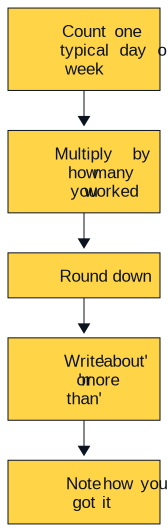
Here's one estimate worked through, as an illustration:
- Count a sample. On a typical shift you answered around 30 calls.
- Multiply. You worked about four shifts a week, so roughly 120 calls a week.
- Round down. Call it "more than 100 a week", which is safely below your estimate.
- Mark it. Use "about", "more than" or a range, so the reader knows it's approximate.
- Note the method. Write down how you got it in your master resume file, so you can answer the question in an interview months later.
Ranges and words like "about" read as honest because they are. If you're still gathering a figure, write a placeholder such as "[number]" in your draft and don't send the resume until you've filled it in or cut it.
How do you give a number context?
Say what to compare it with. A number on its own can be impressive or meaningless, and the reader can't tell which.
"Top 3 seller" means something on a team of 40 and very little on a team of four. "Handled 25 accounts" says more next to "the team average was 15", if you know that's true. Typical anchors are the team's size, the previous result, the usual time, or the goal you were given.
How do you write a strong bullet with no number at all?
Name the problem, what you did about it, and who it helped. Specific words do the job a number would. This follows the Rutgers advice to describe the purpose of your work and how it helped others.
Compare these, both with no numbers:
- Helped with onboarding
- Rewrote the new-hire checklist after repeated payroll setup errors,
  adding the forms HR needed in the order HR processed them
The second has no figure, but a reader can picture the problem, the fix and why it mattered. If you later learn the errors stopped, add that. If you don't know, leave the result out rather than guess.
To try this on your own bullets, Rolefitly's free resume bullet point generator rewrites each one three ways. Where a result would need a number you didn't give, it shows "[number]" or "[%]" for you to fill in or cut, and it swaps out any number that wasn't in what you typed.
What if your job is preventing problems?
Measure what didn't happen, and over how long. Jobs in compliance, safety, IT support and quality control often succeed when nothing goes wrong, which is hard to see on a page unless you count it. These examples are illustrations:
- "Kept the clinic's sterilization logs audit-ready through three state inspections, with no findings."
- "Maintained backups for 40 laptops, restoring a lost project folder within the same day."
- "Checked every outbound order against its pick list on a 6 a.m. schedule."
Each one names a span, a scale or a routine. If you don't know whether there were findings, describe the work and the scale, and stop there.
What do bullets without hard numbers look like, by job?
These are illustrations of before and after for common jobs, not real resumes. Each "after" assumes every detail in it is true for the person writing it.
| Job | Before | After |
|---|---|---|
| Customer service | Answered customer questions | Resolved about 40 billing and delivery questions a day by phone and chat |
| Admin | Handled scheduling | Scheduled appointments for three doctors, keeping one shared calendar for the front desk |
| Teacher | Taught math | Planned daily lessons for 26 seventh graders, with separate materials for three reading levels |
| Retail | Worked the register | Handled checkout for a high-volume register, balancing the drawer at every close |
| Restaurant | Server | Served a 10-table section on weekend doubles, training two new servers |
| Nursing | Cared for patients | Cared for five to six patients a shift on a medical-surgical unit, charting in Epic |
| Warehouse | Loaded trucks | Loaded outbound trucks on a 6 a.m. schedule, checking each order against its pick list |
| Student | Club treasurer | Tracked spending for a 30-member club across two semesters, reporting monthly to the officers |
None of these needs a percentage. Scope, frequency and audience carry them.
How do you quantify a bullet for a specific job posting?
Take one bullet, find the measures already hidden in it, and reword it in the posting's terms. Tailoring changes wording and order, not facts.
The posting
This job description is an illustration, written for this example. It isn't a real posting.
Office Coordinator, outpatient physical therapy practice, Columbus, OH
You will: manage scheduling for multiple providers. Answer patient questions by phone and email. Verify insurance before visits. Help roll out new office systems.
The bullet before
- Responsible for the front desk. Booked appointments for three
  providers, answered phones, and checked insurance before visits.
  Set up the new online booking system last spring.
It holds four of the posting's requirements and one real number, but it opens with a duty and runs everything together.
The bullets after
- Managed scheduling for three providers
- Verified insurance before patient visits
- Answered the front desk phones
- Set up the practice's new online booking system
Every fact comes from the original. "Booked appointments for three providers" became "Managed scheduling for three providers", the posting's term for the same work, and the one number now leads the first bullet. Nothing new was added: no call volume, no wait-time drop, no email.
If the coordinator counts a typical day and knows they answered about 50 calls, the third bullet can become "Answered about 50 calls a day at the front desk". If they know patients booked online after the switch, they can add that too. Until they've confirmed a figure, it stays out.
What changed
This comparison is an illustration, worked out by hand for this example. It isn't output from running a product.
| Posting asks for | Before | After |
|---|---|---|
| Manage scheduling for multiple providers | Buried ("booked appointments") | First bullet, with the number up front |
| Answer patient questions by phone and email | Partly ("answered phones") | Phones only, until email is confirmed |
| Verify insurance | Partly ("checked insurance") | Yes, in the posting's words |
| Help roll out new office systems | Last sentence | Its own bullet |
Three requirements are now easy to spot. Email stays unclaimed, because the bullet never mentioned it. Rolefitly's tailoring follows the same rule: it selects, reorders and rephrases what's already on your resume, you accept or reject each change, and a new fact goes in only if you confirm it's true.
A copyable worksheet for finding your numbers
Copy this into a document and fill it in for each job before you write the bullets.
Job: ______________________

SCOPE      How many people, accounts, items, sites or systems?  ____
FREQUENCY  How often, or how many per day / week / month?        ____
TIME       How fast, how long, or by what deadline?              ____
TENURE     How long did I own this task?                         ____
AUDIENCE   Who used my work? How senior were they?               ____
BEFORE     What was it like before I changed it?                 ____
AFTER      What was different afterward?                         ____
FIRST/ONLY Was I the first or only one to do it?                 ____
CHOSEN     Who picked me, praised me or gave me an award?        ____

For every number above:
[ ] I can explain how I know it in one sentence
[ ] Approximate figures say "about", "more than" or a range
[ ] It has context (team size, previous result or goal)
[ ] It isn't confidential to my employer
[ ] It describes my part, not the whole team's result
What are the most common mistakes when quantifying?
These are the habits that make honest experience look weaker, or make strong experience look made up.
- Inventing a figure. A made-up percentage falls apart at the first interview question. Fix: use scope, frequency or a before and after you can explain.
- Being too precise. "Improved efficiency by 37.4%" invites questions you can't answer. Fix: round, and write "about" or a range.
- A number with no context. "Top 3" means little without the team size. Fix: add what to compare it with.
- Counting effort instead of results. "Worked 50+ hours a week" is a number but not an achievement. Fix: count what the hours produced.
- Claiming the team's number. Fix: give the team's result and name your part.
- Revealing confidential data. Fix: use rounded or relative figures, or describe scope instead.
- Letting AI fill in metrics. AI tools add results you never gave them. Fix: check every number against your own records, and cut what you can't confirm.
- Giving up on a job because it "has no numbers". Fix: run the worksheet above. Most jobs have at least scope and frequency.
How do you check your numbers before you apply?
Read each bullet with a number and ask two things: can I explain this in an interview, and does it prove something this posting asks for? Cut or rewrite any bullet that fails the first. Move down any bullet that fails the second.
For the rest of the bullet, including verbs, formulas, length and tense, see the full guide to writing resume bullet points. To reword your bullets for one posting, see how to tailor your resume to a job description.