

Your resume skills section should hold hard skills: the tools, software, certifications and languages a posting names that you really have, in the posting's wording. Soft skills belong in your bullets. In 4,800 recent job postings we measured, communication skills ranked in the top three in every one of 12 roles, so listing it can't set you apart. Showing it can.
Communication made the top three in every role
Rolefitly reads open job postings on employers' own careers sites and records which skills each one names. For our skills-by-role data, we took the 400 newest postings in each of 12 role families, from nursing and warehouse work to software engineering, as of November 21, 2026.
One skill sat near the top of every list. Communication skills was the most-named skill in six roles, second in five and third in one. It was named in 45% of warehouse postings and in 72% of medical assistant postings.
Source: Rolefitly, skills by role, 4,800 postings, data as of November 21, 2026
See the data as a table
| Value | |
|---|---|
| Medical assistant | 72% |
| Customer service | 66% |
| Customer success | 65% |
| IT support | 63% |
| QA and testing | 56% |
| Retail and sales | 55% |
| Product management | 51% |
| Software engineering | 47% |
| Data and AI | 47% |
| DevOps and cloud | 47% |
| Nursing | 46% |
| Warehouse | 45% |
Across every kind of job, the pattern holds. In the 400 newest postings of any kind, measured for Rolefitly's free ATS keyword checker, 56% named communication skills. The most-named tools on the same list, Excel and Python, each appeared in 9%.
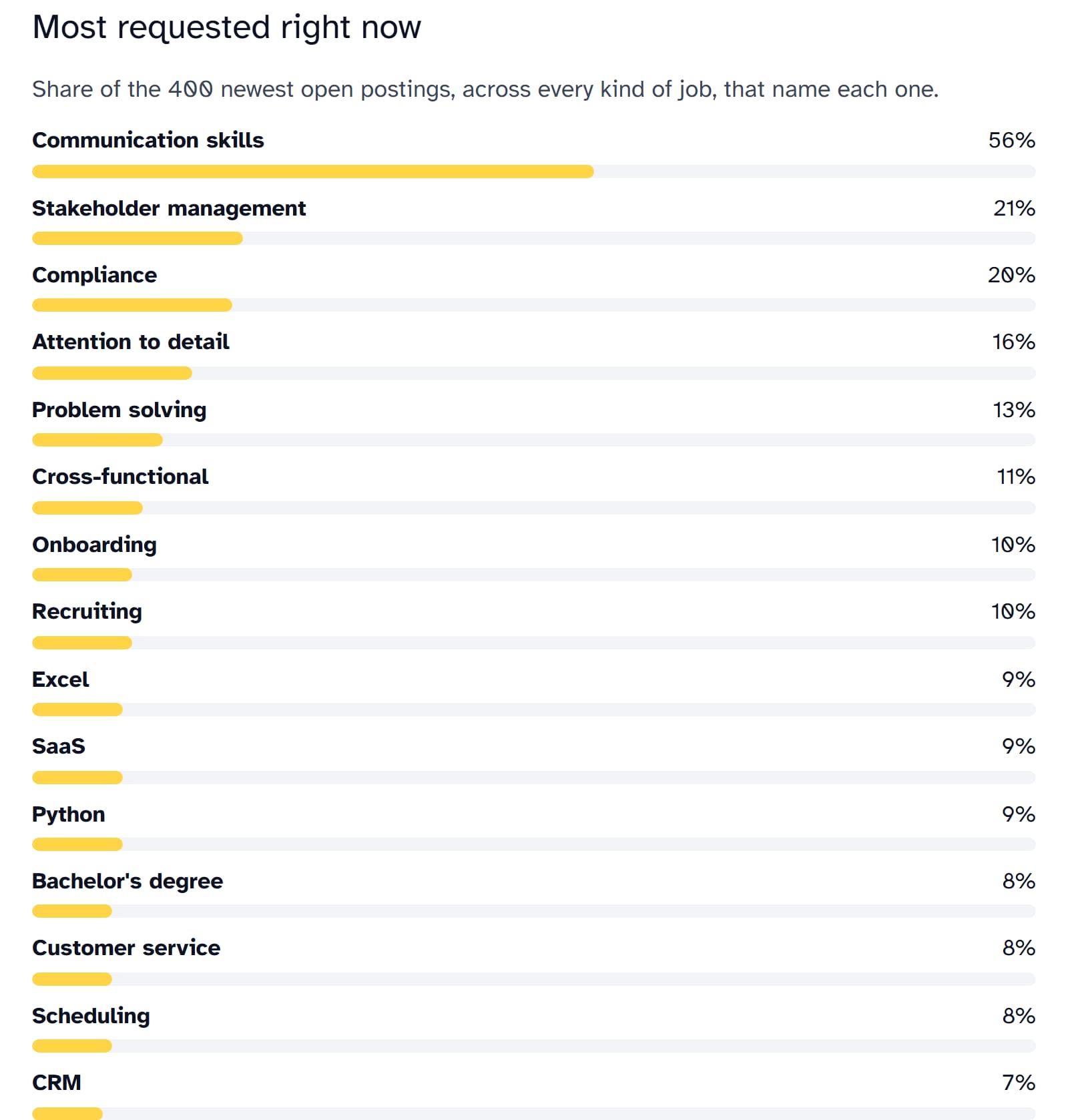
Other soft skills showed up less than you might expect. Problem solving made the top eight in four roles, at 23% to 30% of postings. Attention to detail made it in three. Teamwork made the top eight only for medical assistants, at 33%. That's despite employers in NACE's Job Outlook 2025 survey saying nearly 80% look for teamwork on college students' resumes. Employers value it. They just rarely write the word into the posting.
The skill that tells roles apart
If almost every posting asks for communication, the word doesn't tell a reader which job you're right for. The job-specific skills do. Here is communication next to the hard skill each role names most.
Source: Rolefitly, skills by role, 4,800 postings, data as of November 21, 2026
See the data as a table
| Communication skills | Most-named job skill | |
|---|---|---|
| Medical assistant (patient care) | 72% | 71% |
| IT support (troubleshooting) | 63% | 68% |
| Data and AI (Python) | 47% | 65% |
| Product management (product roadmap) | 51% | 63% |
| Warehouse (inventory management) | 45% | 56% |
| Customer success (account management) | 65% | 55% |
| Nursing (patient care) | 46% | 47% |
| DevOps and cloud (AWS) | 47% | 44% |
| Software engineering (Python) | 47% | 41% |
| Customer service (customer service) | 66% | 53% |
| QA and testing (Python) | 56% | 41% |
| Retail and sales (CRM) | 55% | 29% |
In some roles the job skill is named more often than communication: Python in data and AI postings, troubleshooting in IT support, product roadmap in product management. In others it's named less often but is far more specific. A retail and sales posting that names CRM is telling you something communication doesn't: which tool you'll use every day.
What goes in your skills section
Treat the section as a short, scannable list of what you can do with your hands on the keyboard or the job: tools, software, equipment, methods, certifications, licenses and languages.
- Start from the posting. List every skill, tool and credential it names. The guide to finding keywords in a job description walks through it.
- Keep the ones you really have. The University of Georgia's career center advises listing only skills you've practiced in an experience that's also on your resume.
- Use the posting's wording. If it says "Office 365", don't write only "Microsoft products".
- Order by relevance. Put the skills this posting names first, and group them under short labels when the list runs long.
- Write each skill as plain text. Skip rating bars and icons, which can vanish when software reads the file. The guide to an ATS-friendly resume covers the layout.
How many is enough? Experts disagree. In a CNBC piece on the skills section, one career coach recommends picking six you're truly strong in, and another suggests no more than three or four top skills an employer covets. Let the posting decide: a software role that names a dozen tools you use deserves a longer list than a warehouse role that names four. The software engineer resume examples include grouped skills lines for back-end and front-end roles.
Here is what that looks like for an IT support applicant. It's an illustration, not a real person's resume:
Skills
- Support tools: ServiceNow, Active Directory, Office 365
- Networking: TCP/IP, DNS, troubleshooting Wi-Fi and VPN connections
- Certifications: CompTIA A+
- Languages: Spanish (conversational)
Each line names something a recruiter could search for, and each item would also appear in a bullet further down.
Where your soft skills go instead
You don't drop soft skills. You move them to where they can be believed. NACE's Job Outlook 2026 Spring Update found employers want candidates who can work in a team, solve problems and communicate effectively, and that they want to see examples of those skills rather than a list.
So instead of "Communication skills" in the list, write a bullet where the communication did something. For the same illustrative IT support applicant:
Wrote the step-by-step guides the help desk used for password resets and VPN setup, so new staff could fix common problems without opening a ticket.
That bullet shows written communication and problem solving without naming either. The guide to resume bullet points covers how to build bullets like it.
One exception: if a posting names a soft skill outright, such as "bilingual" or "attention to detail", and you have it, it's fine to use those exact words somewhere on the resume, ideally inside a bullet that proves it.
How we measured this
- The postings. For each role, the 400 newest open postings on employers' own careers sites, not job boards. A posting counts once per employer and job title, and no single employer makes up more than a fifth of a role's sample.
- The skills. We read each description and recorded which skills, tools and credentials from a fixed list it names, matching whole words and common spellings. "Communication" and "written and verbal" count as communication skills. "Team player" counts as teamwork.
- The figures. A share is the fraction of the 400 postings that name the skill. The data page shows each role's top eight skills, and leaves out any skill named in fewer than 3 postings.
- The date. The figures were read on November 21, 2026. They update every few hours as postings open and close, so the live page may differ from this post.
The limits of these figures
These numbers count words in postings. They can't show:
- What gets interviews. A skill being named often doesn't mean listing it gets you hired. We measured what employers write, not who they pick.
- How much a skill matters. "Communication" can appear in one passing line or in the core duties. Both count the same.
- Every way of saying it. A posting that asks you to "collaborate across teams" doesn't count as naming teamwork, which may be one reason teamwork rarely made a top eight.
- Boilerplate. Some terms, such as recruiting and compliance, likely appear in equal-opportunity and legal text rather than in the job itself. That's why we left them out of the comparison above.
- Roles we didn't measure. The data covers 12 role families. Teaching, the skilled trades and finance, for example, aren't among them.