

To write a resume bullet point, start with an action verb, say what you did and how, then show what changed because of it, with a number if you have one. Keep it to one or two lines. Then reword it in the posting's language for work you really did, so the recruiter sees the match quickly.
What is a resume bullet point?
A resume bullet point is a short line under a job, project or activity that describes one thing you did and why it mattered. Each job on a resume usually gets a few of them.
Bullets carry most of the proof on your resume. Your job titles and dates say where you were. The bullets say what you can do, which is what a recruiter is trying to find out.
What makes a resume bullet point good?
A good bullet is specific, starts with a verb, and shows a result or scale. The Harvard College guide to creating a strong resume asks for language that is "specific rather than general", "active rather than passive" and "fact-based", meaning quantified and qualified.
Compare these two:
- Responsible for customer emails
- Answered about 40 customer emails a day, resolving most without escalation
The first is a duty, which tells the reader what you were supposed to do. The second is an accomplishment: what you did, how much, and how well. The second only works if every part of it is true for you.
What is the XYZ formula for resume bullets?
The XYZ formula is "Accomplished X as measured by Y by doing Z". Laszlo Bock, Google's former chief human resources officer, shared it in a 2014 LinkedIn post on how to write a better resume.
- X is what you accomplished, starting with an active verb.
- Y is how it was measured, ideally with a comparison, so the reader knows if it's a big deal.
- Z is what you did to get there.
Bock's own example rewrites "Studied financial performance of companies and made investment recommendations" into a bullet with a percentage, a dollar amount, a time frame and a method. Some guides now treat Y as "context" rather than a measurement. That's softer than the original, but it's useful when you have no numbers, which is covered below.
You don't need to keep the formula's wording. "Accomplished" and "as measured by" rarely appear in a finished bullet. The parts matter, not the phrase.
What are the other bullet formulas, and which should you use?
Every formula asks the same three things: what you did, how, and what came of it. Pick the one that matches the story you're telling.
| Formula | Stands for | Best for | Where it comes from |
|---|---|---|---|
| XYZ | Accomplished X, measured by Y, by doing Z | Results you can measure | Laszlo Bock, 2014 |
| PARQ | Problem, Action, Result, Quantify | Projects that fixed something | Virginia Tech's career center |
| PAR or CAR | Problem (or Challenge), Action, Result | Bullets without a clean metric | Many university career centers |
| STAR | Situation, Task, Action, Result | Interview answers, then trimmed into a bullet | Common interview method |
| WHO | What you did, How you did it, Outcome | Quick first drafts | UNC Chapel Hill's career center |
STAR has four parts, which is usually too many for one line. Use it to remember the story, then keep only the action and result for the bullet.
How do you turn a duty into an accomplishment?
Start from the duty, then add a verb, a method and a result, one step at a time. Most weak bullets are duties that stopped at step one.
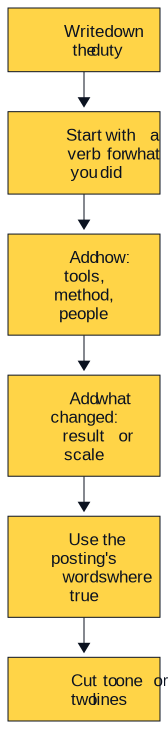
Here's one duty taken through the steps:
- Duty: "Responsible for the front desk schedule"
- Verb: "Scheduled front desk shifts"
- How: "Scheduled front desk shifts for 12 staff in a shared calendar"
- What changed: "...so every opening hour was covered, including holidays"
- Posting's words: if the job asks for "staff scheduling", use that phrase.
- Cut: "Scheduled shifts for 12 front desk staff, keeping every opening hour covered"
The details in step 3 and 4 have to be yours. If you don't know the staff count, leave it out rather than guess.
What action verbs should a bullet start with?
Start with a verb that names your real part in the work. A precise verb does more than a dramatic one, and "spearheaded" on every line reads as filler.
| Instead of | Try, when it's accurate |
|---|---|
| Responsible for | Managed, ran, owned, oversaw |
| Helped with | Supported, contributed to, assisted, co-led |
| Worked on | Built, wrote, designed, tested, analyzed |
| Did | Completed, delivered, produced, prepared |
| Was in charge of | Led, supervised, directed, coordinated |
| Talked to customers | Advised, resolved, answered, trained |
| Made better | Improved, reduced, streamlined, cut |
UNC's career center names "Responsible for" and "Helped with" as phrases to avoid. "Helped" can still be honest when your part was small, so swap it for a verb that says what that part was.
To try this on your own bullets, the free resume bullet point generator rewrites each one three ways, as action, what you did and the result. It keeps your facts and marks where a real number would help instead of making one up.
How do you quantify a bullet when you don't have numbers?
Measure something other than revenue. Almost every job has a scale, a frequency, an audience or a before and after, and each of those counts.
- Scale: how many people, items, accounts, pages or locations. "Managed inventory for a 3,000-item stockroom."
- Frequency: how often. "Prepared the weekly sales report."
- Who it served: the audience or level. "Wrote meeting notes for the department director."
- Before and after: what was different afterward, even without a number. "Replaced the paper sign-in sheet with a shared spreadsheet."
- Recognition: what someone else said or chose. "Chosen to train new hires on the register system."
- Time: how fast or how long. "Closed the month's books within the first week."
Estimates are fine when you can explain them in an interview. Write "about" or "more than" when a figure is approximate, and never write one you can't defend. For a step-by-step way to estimate, examples by job and a worksheet, see how to quantify your resume without numbers.
How many bullet points should each job have?
Use three to five for your most recent and relevant jobs, and one to three for older or less relevant ones. There's no fixed rule, so let the job's relevance decide, not its length.
A job that matches the posting closely deserves more space. A summer job from six years ago may need one bullet, or none if it proves nothing the posting asks for. If your resume runs long, cut weak bullets before you shrink the font.
How long should a resume bullet be?
One line is ideal and two is the limit. If a bullet runs to three lines, it's usually two bullets, or it has a clause that can go.
Read each bullet and ask what the last half adds. "In order to", "on a daily basis" and "various" can almost always be cut.
Should bullets be in past or present tense?
Use past tense for jobs you've left. For your current job, use present tense for ongoing work and past tense for finished projects, or past tense throughout. Whichever you pick, stay consistent within a job.
Virginia Tech's career center gives the same rule: past tense for completed experiences, and either tense for ongoing ones. Mixing "Manage" and "Managed" under one job looks careless, even if each is defensible.
Do resume bullets need periods?
No, most resume bullets don't end with a period, because they aren't full sentences. Periods are allowed, as long as every bullet on the page does the same.
Pick one style and check it in the final proofread. Inconsistent punctuation is one of the easiest errors for a reader to spot.
Should bullets use "I" or other pronouns?
No. Drop "I", "my" and "we" and start with the verb. Both Harvard's and UNC's career centers tell students to leave personal pronouns out.
"I managed the schedule" becomes "Managed the schedule". The reader already knows the resume is about you.
What order should bullets go in?
Put the bullet that best proves the posting's top requirement first. Recruiters skim, so the first one or two bullets under each job do most of the work.
This means the order can change for each application. A master resume, with every bullet you've ever written, makes that quick. The guide to tailoring your resume to a job description covers the full process.
How do you tailor bullet points to a job description?
Find the posting's main requirements, then reword your existing bullets so they use the posting's terms for work you really did. You change wording and order, never the facts. If a chatbot does the rewording, using AI to tailor your resume covers safe prompts and the line-by-line check.
Here's one posting and one bullet, before and after.
The posting
This job description is an illustration, written for this example. It isn't a real posting.
Marketing Assistant, regional health nonprofit, Denver, CO
You will: create social media content for Instagram and LinkedIn. Report on campaign performance each month. Coordinate community events with the outreach team. Write email newsletters in Mailchimp.
The bullet before
A recent graduate ran social media for a student club. Their resume has one bullet for it:
- Responsible for the club's social media and helped with events.
  Posted on Instagram three times a week and put together a monthly
  report on follower growth.
The relevant work is all there. But it opens with "responsible for", mixes two kinds of work in one bullet, and buries the report at the end.
The bullets after
- Created and posted Instagram content three times a week for a
  student club
- Reported monthly on Instagram follower growth
- Helped run club events
Every fact comes from the original bullet. "Put together a monthly report" became "Reported monthly", the posting's verb for the same work. The events line stays vague, because the original says only "helped", and adding detail would mean adding facts. If the graduate remembers what they did at those events, such as booking the room, that detail can go in once they've confirmed it.
If the graduate knows the real follower numbers, the second bullet can become an XYZ bullet: "Grew the club's Instagram following from [start] to [end] in [months] by posting three times a week". Fill the brackets only with figures they can back up.
What changed
This comparison is an illustration, worked out by hand for this example. It isn't output from running a product.
| Posting asks for | Before | After |
|---|---|---|
| Create social media content | Partly ("posted on Instagram") | Yes, "created and posted Instagram content" |
| Report on campaign performance | Buried at the end | Its own bullet, in the posting's words |
| Coordinate community events | Weak ("helped with events") | Still weak, until a real detail is added |
| Write email newsletters in Mailchimp | No | Still no |
Two requirements now show clearly. Events stay weak and newsletters stay unmet, because the bullet never said more, and tailoring can't add it. LinkedIn is also missing: the graduate only posted on Instagram, so the bullet shouldn't claim both.
Rolefitly's tailoring works by the same rule. It selects, reorders and rephrases what's already on your resume, and you accept or reject each change. A new fact goes in only if you confirm it's true. For more on picking the right terms, see how to find keywords in a job description.
Resume bullet point examples by situation
These are illustrations of the before and after for common situations, not real resumes. The "after" lines assume the details in them are true for the person writing them.
| Situation | Before | After |
|---|---|---|
| Retail | Worked the register | Handled checkout for about 150 customers a shift, balancing the drawer at close |
| Customer service | Answered phones | Resolved billing questions by phone, escalating only account closures |
| Admin | Did filing | Moved paper client files into a shared drive, organized by account |
| Student project | Group project on marketing | Wrote the survey for a four-person market research project, collecting 80 responses |
| Volunteer | Volunteered at food bank | Sorted and packed donations weekly, training new volunteers on the intake process |
| Internship | Helped the data team | Cleaned and merged weekly sales data in Excel for the analytics team's dashboard |
| Teaching | Taught 5th grade | Planned daily lessons for 28 fifth graders, adapting materials for three reading levels |
| Warehouse | Loaded trucks | Loaded outbound trucks on a 6 a.m. schedule, checking each order against its pick list |
Swap in your own facts. If you can't say "about 150 customers" with confidence, write "a high-volume register" instead.
For engineering roles, the software engineer resume examples show before-and-after bullets for cloud, front-end, new grad and career-change situations, with the keywords each one covers.
A copyable bullet checklist
Copy this and run each bullet through it before you send your resume.
For each bullet:
[ ] Starts with a verb, with no "I" or "my"
[ ] Says what I did, not what I was responsible for
[ ] Says how: a tool, method or who I worked with
[ ] Shows a result, scale or frequency
[ ] Every number is one I can explain in an interview
[ ] Uses the posting's term where it's true for me
[ ] One or two lines long
[ ] Same tense as the other bullets in this job
[ ] Same punctuation as every other bullet

For each job:
[ ] The bullet that best fits the posting comes first
[ ] Three to five bullets for recent, relevant jobs
[ ] One to three, or none, for old or unrelated jobs
What are the most common bullet point mistakes?
These are the habits that make good experience read as weak, each with its fix.
- Listing duties. "Responsible for scheduling" says what the job was, not what you did. Fix: start with a verb and add the result or scale.
- Padding with numbers you can't defend. A made-up percentage falls apart at the first interview question. Fix: use scale, frequency or a before and after instead.
- Overclaiming your role. Writing "led" when you contributed. Fix: use the verb that matches your real part, and name the team.
- Two ideas in one bullet. The second one gets lost. Fix: split it into two bullets, each with its own verb.
- Copying the posting's sentences. It describes the job, not you. Fix: use the posting's terms inside your own sentence about your own work.
- Starting every bullet with the same verb. Five lines of "Managed" blur together. Fix: vary the verbs, choosing the most precise one for each.
- Buzzwords instead of proof. "Results-driven self-starter" proves nothing. Fix: cut it and let a bullet show the result.
- Mixed tense and punctuation. It looks careless. Fix: check both in a final read-through, job by job.
If your bullets are strong and you're still not hearing back, the cause may be elsewhere. See why you might not be getting interviews for the other usual reasons.
How do you check your bullets before you apply?
Read each bullet next to the posting and ask which requirement it proves. A bullet that proves nothing the employer asked for is a candidate to move down or cut.
Then read the resume out loud. Bullets that are hard to say are usually hard to read, and the typos show up too.
The searches this answers include "resume bullet points examples", "how many bullet points per job on resume", "bullet resume", "bullet points for resume", and "bullets in resume".