

To tailor a cover letter to a job, pick the two or three requirements the posting stresses most, prove each one with a real example from your resume, and open with a specific detail about this employer or role. Change which proof you lead with and why you want this job, never the facts. Here's how.
What does it mean to tailor a cover letter?
A tailored cover letter answers one posting's most important requirements with your own examples, and says why you want this particular job. It's written for one reader, about one role.
That's different from personalizing a letter. Swapping in the company name and job title makes it look custom, but the body still says the same thing to everyone.
Drexel's career center puts it simply: no two job descriptions are the same, so no two cover letters should be either.
Should you tailor your cover letter for every job?
Yes, for every job you'd really take. A generic letter tells the reader nothing your resume doesn't, so it rarely helps and can hurt. Whether yours gets read at all depends on who opens it, which is covered in do recruiters still read cover letters.
What you can do is make tailoring faster. Keep a base letter with parts that don't change, and rewrite only the parts that answer this posting, as shown in the template below.
If you're applying to many jobs, it helps to tailor your resume first. The step-by-step guide to tailoring your resume has you match each requirement to proof, and that list becomes the outline for your letter.
What does a cover letter add that your resume doesn't?
The resume lists what you did. The letter explains why you want this job and how your experience answers what this employer needs.
MIT's career office advises adding detail to your resume rather than repeating it, and linking the skills you've built back to the target role. So a tailored letter isn't your resume in paragraphs. It picks a few lines from it and tells the story behind each one.
How do you tailor a cover letter to a job, step by step?
Work through six steps, from reading the posting to checking the finished letter. Each step uses what the one before it found.
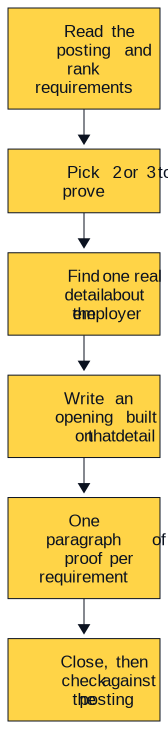
Step 1: Read the posting and rank the requirements
Read the whole posting twice, then mark what's required and what's preferred. Requirements are usually listed from most to least important, so their order is a clue.
St. Olaf College's career center suggests reading once for the role and once for the skills, underlining key words, and planning your letter in the same order as the posting. For a closer method, see how to find keywords in a job description.
Step 2: Pick two or three requirements to prove
Choose the requirements that matter most and that you can prove best. A letter that tries to cover everything ends up proving nothing.
Drexel's guide suggests focusing on one or two skills that match what the position needs, and MIT's suggests a body of two or three paragraphs. Either way, fewer, stronger examples beat a list.
Step 3: Find one real detail about the employer
Look for one specific thing about this employer or role that connects to you. It might be who they serve, a problem the role exists to solve, or how the team works.
MIT suggests using the job description and the company's website or LinkedIn page to find the traits and skills the company values. Use what they actually say, in plain words. Don't claim research, conversations or feelings you don't have.
Step 4: Write an opening built on that detail
Your first lines should name the role and connect that detail to you. Skip "My name is" and "I am writing to apply", because your name and the job title are already on the page.
A good opening is short, about two or three sentences. If you have a real connection, such as someone you spoke to at the company or a product you've used, lead with it.
Step 5: Write one proof paragraph per requirement
Give each requirement its own short paragraph. Start with the result, using your resume's own numbers, then say how you did it and why it matters for this role.
Use the employer's term for work you really did. If they say "vendor management" and you reordered supplies from six vendors, you can call it managing vendor orders. If you never did it, leave it out. For help turning duties into results, see how to write resume bullet points, since the same method works here.
Step 6: Close, then check it against the posting
Thank the reader, restate the strongest reason you fit, and ask for a conversation. Two sentences is enough.
Then go back to the requirements you picked in step 2. For each one, check that a reader would find your proof in a few seconds, and that every claim in the letter also appears on your resume.
How long should a tailored cover letter be, and who do you address it to?
Keep it to one page. Boston University's career center recommends 1 page with at most 3-4 paragraphs, and MIT says no longer than one page, with a font size between 10 and 12 points.
Address a named person if you can find one, usually the hiring manager or your future supervisor. If you can't, both MIT and BU say a generic greeting such as "Dear Hiring Manager" or "Dear Hiring Committee" is fine.
If the posting has a job reference number, include it near the top. MIT notes it helps HR match your letter to the right opening.
What should you change in each cover letter, and what can stay the same?
Change the opening, the proof you choose and the closing line. Keep your header, contact details, sign-off and anything true about you that every employer needs to know.
| Part of the letter | Change for each job | Can stay the same |
|---|---|---|
| Header and contact details | Nothing | Same as your resume |
| Greeting | The person's name, or the right team | The format |
| Opening | The role, and the detail about this employer | Nothing, rewrite it each time |
| Proof paragraphs | Which requirements you answer, and the terms you use | The facts and numbers in each story |
| Why this employer | The reason, based on this posting or company | Nothing, rewrite it each time |
| Closing | The single strongest reason you fit this job | Thanks and the request to talk |
| Sign-off | Nothing | "Sincerely," and your name |
A useful habit is to keep a file of proof paragraphs, one per skill you're often asked for. Then tailoring is mostly choosing two or three and adjusting their wording to this posting.
What does a tailored cover letter look like? A worked example
Here's one posting, one candidate and two letters, generic and tailored. Every claim in the tailored letter comes from the candidate's resume.
The posting
This job description is an illustration, written for this example. It isn't a real posting.
Operations Coordinator, home services company with three locations (US)
Requirements: Keep technician schedules up to date across locations. Place and track parts orders with vendors. Build weekly reports in Excel. Experience with scheduling software.
Preferred: 1+ years in field service or the trades.
The candidate's resume
The candidate has been an office assistant at a dental practice for three years. These are the lines on their resume:
- Scheduled appointments for 4 dentists in Dentrix.
- Reordered supplies from 6 vendors and tracked deliveries in Excel.
- Built a weekly Excel report of missed appointments, which the office manager used to plan reminder calls.
- Answered phones and checked in patients.
The generic letter
Dear Hiring Manager,
I am writing to apply for the Operations Coordinator position at your company. I am a hard-working, detail-oriented team player with three years of office experience.
In my current role I answer phones, check in patients, schedule appointments and order supplies. I am a fast learner and I work well under pressure.
I believe I would be a great fit for your team. Thank you for your consideration.
The tailored letter
Dear Hiring Manager,
Your posting describes a coordinator who keeps technician schedules, parts orders and weekly reports in step across three locations. I've done the same kind of work for the past three years at a dental practice, and I'd like to bring it to your Operations Coordinator role.
I keep several people's schedules in one system. I schedule appointments for 4 dentists in Dentrix, so working in scheduling software and keeping more than one calendar current is part of my everyday job.
I also handle vendor orders and weekly reporting. I reorder supplies from 6 vendors and track each delivery in Excel, and I build a weekly Excel report of missed appointments that our office manager uses to plan reminder calls.
Thank you for your time. I'd welcome a conversation about how my scheduling and vendor experience could help your three locations.
What changed, and why
| Requirement | Generic letter | Tailored letter |
|---|---|---|
| Technician schedules | "schedule appointments", no detail | 4 dentists' schedules, tied to the role |
| Vendor orders | "order supplies" | 6 vendors, each delivery tracked |
| Weekly Excel reports | Not mentioned | The weekly missed-appointment report |
| Scheduling software | Not named | Dentrix, named |
| Field service (preferred) | Not shown | Still not shown, because the candidate hasn't done it |
The generic letter proves none of the four requirements. The tailored one proves all four, with a specific example for each, and it's still under one page.
Notice what didn't happen. The tailored letter doesn't claim field service experience, doesn't turn dental scheduling into "dispatching technicians", and doesn't add a number that isn't on the resume. The 3 years, 4 dentists and 6 vendors are unchanged. It also drops "team player" and "fast learner", which any applicant could write.
A tailored cover letter template you can copy
Copy this template and replace every bracket. The comments after each part say what to change for each job.
[Your name]
[City, State] | [Email] | [Phone] | [LinkedIn, optional]

[Date]

Dear [Name, or Hiring Manager],

[Opening: 2-3 sentences. Name the role. Connect one specific, true
detail about this employer or role to your own experience or interest.]

[Proof 1: 2-3 sentences. The posting's most important requirement you
meet. Result first, with the numbers from your resume, then how you did
it, then why it matters for this role.]

[Proof 2: 2-3 sentences. The next requirement, same pattern.]

[Optional, why this employer: 1-2 sentences, if the opening didn't
already cover it.]

Thank you for your time. [One sentence restating the strongest reason
you fit, and asking for a conversation.]

Sincerely,
[Your name]
Before you send it, run through this checklist:
- The opening names this role and a detail specific to this employer
- Each proof paragraph answers one of the posting's top requirements
- Every number and claim also appears on my resume
- I used the employer's terms only for work I really did
- No sentence is copied from the posting
- No other company's name or role is left in the letter
- It fits on one page, with the same header and font as my resume
What are the most common cover letter tailoring mistakes?
Most mistakes come from personalizing instead of tailoring, or from saying too much. Here are the ones to watch for, with a fix for each.
- Only swapping the company name. The rest of the letter still fits any job. Fix: rewrite the opening and choose proof paragraphs for this posting's top requirements.
- Opening with "I am writing to apply". It wastes the first line, which is the one most likely to be read. Fix: open with the detail about this employer or role, and name the job in the same sentence.
- Repeating your resume in paragraphs. The reader learns nothing new. Fix: pick two or three lines and tell the story behind each, as MIT and Drexel both advise.
- Copying sentences from the posting. It describes the job, not you. Fix: use their term inside your own sentence about your own work.
- Claiming a skill or result you don't have. It comes apart in the interview. Fix: prove what you have, and if a missing preferred skill matters, say how you're learning it.
- Covering every requirement. A letter that tries to answer everything gets long and thin. Fix: answer the two or three that matter most, and let your resume cover the rest.
- Writing about what you want from the job. Readers want to know what you'll do for them. Fix: tie each example back to what this role needs.
- Sending the last company's version. A leftover name is an easy reason to stop reading. Fix: search the letter for the previous employer's name before every send.
Can you use AI to tailor a cover letter?
Yes, as long as every claim in the result is true and you'd say it in your own words. AI is good at structure and wording, and bad at knowing what you've really done.
The main risk is invented detail: a number, a tool or a reason for wanting the job that sounds right but isn't yours. Treat any AI draft as a first pass, check each claim against your resume, and rewrite anything that doesn't sound like you. The same check applies to your resume, and using AI to tailor your resume walks through it step by step.
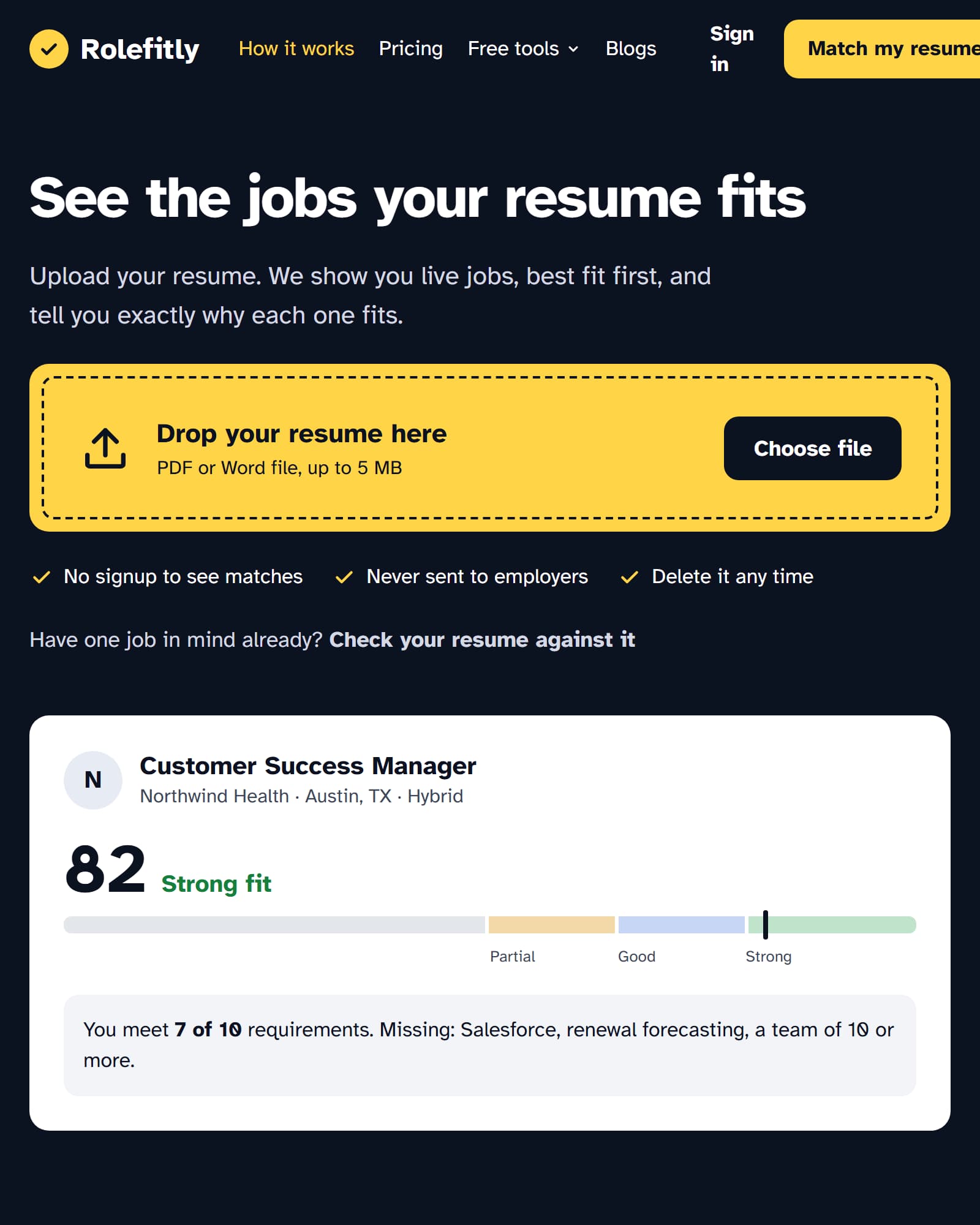
Rolefitly's free cover letter generator is built around that risk. It writes only from your resume and the posting, and lists the resume line behind each requirement it answers, so you can check every claim before you send it.
Rolefitly's cover letter is built around that risk. It starts from the requirements your resume already meets for that job, most important first, with the line from your resume that proves each one. You choose a tone and a length, from short at about 150-200 words to long at about 330-400, and you can add a note about your own connection to the company, which is used for the opening.
Each paragraph is then checked against your resume and your note. Any paragraph that makes a claim neither one supports is left out, rather than sent to you as if it were true. You can download the letter as a PDF or a Word file and edit it before you send it. On the free plan, each of your 2 tailored applications includes the tailored resume and its cover letter.
Where should you start?
Pick one job you'd really take, and list its top three requirements. Then find one line on your resume that proves each one, and you have the outline of a tailored letter.
For more on this, see ats friendly resume.