

Usually, yes. Apply if you meet the requirements marked required and most of the rest, and you can point to proof on your resume. Postings describe an ideal candidate, and most employers don't expect a perfect match. Skip the job when what you lack is a license, a legal minimum, or several of the core skills the work depends on.
Why a posting isn't a checklist
A job posting is written before anyone applies. It often lists everything the team would like, in one block, with no weights. Colorado State University's career center calls many of these lists a wish list and says employers may still consider candidates who don't meet every requirement, especially for entry-level jobs.
The best numbers on this come from an Indeed report published in 2021. The employers Indeed asked said a candidate needs to meet an average of 70% of the job requirements to be considered. In its survey of 500 US job seekers, the average answer was the same 70%. The same report found that about a third of those job seekers had skipped a job because they lacked the listed experience, education or technical skills.
So neither side, on average, expects 100%. If you wait for a perfect match before you apply, you're holding yourself to a stricter bar than the employer does.
The 60% and 100% statistic
You have probably read that men apply when they meet 60% of the qualifications and women only at 100%. It's quoted everywhere, including in LinkedIn's 2019 gender report. The Behavioural Insights Team traced it back to a comment by a Hewlett Packard executive, and found no data behind it.
What LinkedIn did measure is more useful. In its analysis of member behavior, women applied to 20% fewer jobs than men, but were 16% more likely to be hired when they did apply. LinkedIn didn't measure how qualified those applicants were, so this doesn't prove anyone screened themselves out too early. It does show that applying less is not the same as being a weaker candidate.
The case against applying anyway
"Always apply" is bad advice too. Three kinds of gap usually end an application whatever your cover letter says.
Knockout questions. Many application forms ask yes-or-no questions before anyone reads the resume, such as "Do you have at least 3 years of experience in customer support?" Colorado State's career center warns that a degree or years-of-experience requirement can appear as one of these knockout questions, and a "no" can end the application there. Answer them honestly. A false "yes" is likely to come out in the interview or a reference check.
Legal and formal minimums. A nursing license, a commercial driver's license, a security clearance or a required certification is not a preference. Neither is a government posting's minimum qualification. Idealist notes that "minimum" in federal job postings works as a hard screen.
Several core gaps at once. One missing tool is a gap. Missing the main tool, the years and the field is a different job. Your applications are limited, and each one sent to a long shot is one not sent to a job you fit. The guide to how many jobs to apply to per day shows what the data says about sending more.
When the answer changes
| What you're missing | Apply? | Why |
|---|---|---|
| A preferred or "nice to have" item | Yes | Preferred items are what the employer would like, not what it requires |
| A degree, when the posting says "or equivalent experience" | Yes, if you have the experience | The posting has already said it accepts another route |
| A year or so of the experience asked for | Yes | Close gaps are normal. Show what you did in the years you have |
| Several years, such as 2 against 7 asked | Usually no | The role is likely a level above yours. Apply one level down |
| One tool, when you've used a similar one | Yes | Name the tool you used. Don't rename it as theirs |
| A license or certification required by law | No, unless you'll have it soon | The employer can't hire you without it |
| A federal posting's minimum qualification | No | It's a formal screen, not a preference |
| Most of the core requirements | No | No resume or letter can close that gap |
One posting, sorted line by line
Here's how that works on a single posting. Both the posting and the candidate are an illustration, not a real employer or person.
The posting is for a customer support specialist. The candidate has two years in support at a software company.
| Requirement | Marked | The candidate's proof | Verdict |
|---|---|---|---|
| 3+ years in customer support | Required | 2 years in support | Short, but close |
| Zendesk or a similar ticketing system | Required | "Resolved Zendesk tickets for 140 accounts" | Met |
| Clear written communication | Required | Wrote the team's help-center articles | Met |
| Weekend availability | Required | Yes | Met |
| SaaS experience | Preferred | Support role at a software company | Met |
| SQL basics | Preferred | Nothing on the resume | Missing |
| Bachelor's degree | Preferred | None | Missing |
Every required item but one is met, and that one is a year short, not five. The two missing items are preferred. This is an application worth sending.
Rolefitly's match score also measures an experience gap by its size: the years you have over the years asked, capped at 100. Two years against three asked scores 67 for experience, and experience counts for 15% of the overall score. Skills count for 50%, so meeting the posting's skills, as this candidate does except for SQL, matters more to the score than the missing year. A score like that estimates fit. It doesn't predict an interview.
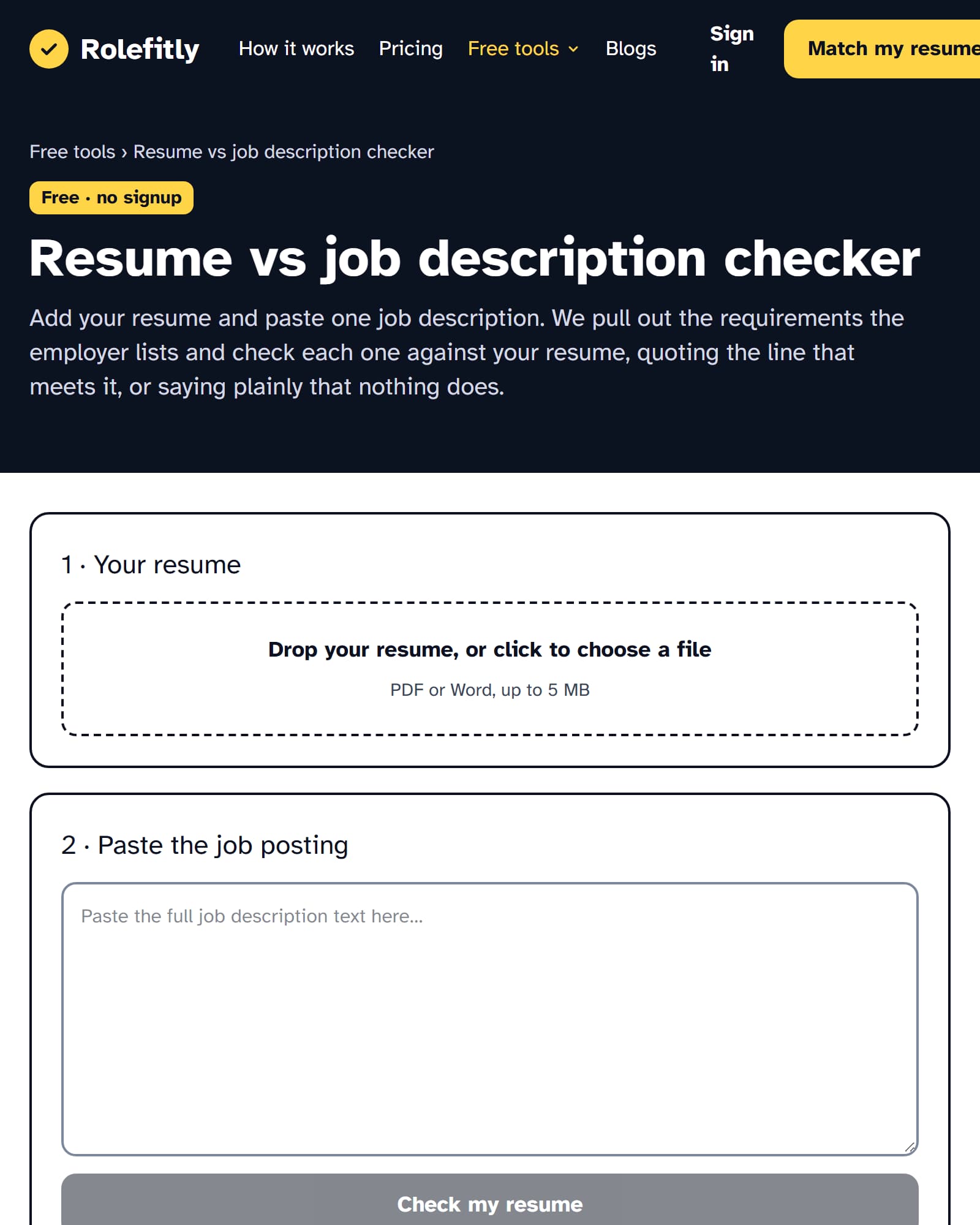
Rolefitly's free resume vs job description checker, linked at the end of this post, does this sort for you. It pulls the requirements out of a posting you paste, then marks each one met, quoting the resume line that meets it, or missing.
How to apply when you're short
Once you've decided to apply, the job is to make the requirements you meet easy to see.
- Put the met requirements first. Move the bullets that prove the required items to the top of each role, in the posting's words. The guide to the resume match score explains how to read what's missing.
- Leave the gaps alone on the resume. Don't stretch a bullet to cover something you didn't do. A requirement you don't meet stays unmet.
- Show progress on a gap, if you have some. A course in progress or a related project belongs in a line of its own, dated honestly.
- Write the letter about fit, not about the gap. A cover letter tailored to the job should answer the two or three requirements that matter most. Don't apologize for what's missing. If the letter is optional, see whether recruiters read cover letters before you decide.
- Answer screening questions truthfully. If an honest answer might knock you out, give it anyway. If you know someone at the company, a short note to the hiring manager may still get your resume read.
If you're applying to many jobs and hearing nothing, the pattern may be the targeting rather than any one gap. The guide to why you're not getting interviews walks through the other causes.