

Two or three a day, or about 10 to 15 a week, is a sensible pace for most people, but only if each one is a job you clearly fit. No study we found tests a daily number. What the data does show is that past a point, more applications don't bring more interviews, so set a weekly count of good-fit jobs and tailor each one.
Where "2 to 3 a day" comes from
Almost every page that answers this question gives the same range. Bentley University's career blog suggests aiming for 2 to 5 applications a day, and says one to two hours a day is enough for two or three. Most career sites repeat two or three a day, usually with no source at all.
That doesn't make the range wrong. It's a practical number: small enough that you can read each posting properly and adjust your resume, and large enough to keep a search moving. Treat it as a time budget, not as a finding about what gets people hired.
What the data says about volume
The best evidence doesn't give a daily number. It shows what happens when volume goes up.
Interviews per application have fallen. Ashby, which makes hiring software, analyzed over 109 million applications to its customers' jobs from 2021 to early 2026. In 2021, about 7 to 8% of applications led to an interview. Now it's between 3.6% and 4.7%, depending on the type of role, which works out to roughly one interview for every 21 to 28 applications. The average recruiter now handles 291 applications per hire, up from about 100 in early 2021.
That average includes every rushed and auto-sent application, so it isn't a forecast for yours. It does explain why sending more of the same moves the needle less than it used to.
Past a point, more didn't help. The nonprofit ideas42 surveyed recent graduates. 32% had sent more than 100 applications, and those who applied to 100+ jobs didn't get any more interviews than those who applied to just 10 or 20. Its own rule of thumb is five quality applications a week, with most of the rest of your time spent on reaching people.
The heaviest appliers heard back least. In a 2017 article, Indeed's senior vice president of HR wrote that Indeed data showed people with the highest number of applications were 39% less likely to get a positive response from employers. Indeed didn't publish how it measured that, so take it as a direction rather than a precise figure.
None of these sources tested a daily number. Together they point the same way: past a modest pace, the extra applications add little, and the time they take comes out of the ones that fit. That's also the catch with auto-apply tools and one-click applications: they raise the count without raising the fit.
Your field may not have 15 good jobs a week
Daily targets ignore the other side: how many postings you fit actually appear. Rolefitly tracks open jobs on 16,160 employers' own careers sites. Here is how many new postings each role family gained in one week.
Source: Rolefitly, open jobs by role, updated November 21, 2026
See the data as a table
| Value | |
|---|---|
| Retail and sales | 1338 postings |
| Software engineering | 1041 postings |
| Customer service | 520 postings |
| Nursing | 388 postings |
| DevOps and cloud | 323 postings |
| Data and AI | 301 postings |
| Product management | 135 postings |
| IT support | 103 postings |
| Warehouse | 94 postings |
| QA and testing | 57 postings |
| Customer success | 50 postings |
| Medical assistant | 26 postings |
Those counts are for the whole country, every level and every city. If you're a QA tester, 3 a day is 15 a week, which is 15 of the 57 new QA postings Rolefitly saw that week, or about a quarter of them, before you filter for your level and location. In customer success it's 15 of 50.
The counts cover only the employers Rolefitly tracks, not every job in the US, so your real pool is larger. But the point holds: in a narrow field, a daily quota pushes you toward jobs you don't fit, just to hit the number. In a big field such as retail or software, the opposite problem applies. There are more good postings than you can tailor for, so you have to choose.
When the answer changes
| Your situation | A workable pace | Why |
|---|---|---|
| Unemployed and searching full time | Toward the top of Bentley's 2 to 5 a day, if the good postings exist | You have the hours. The limit is how many jobs you fit |
| Working full time | Fewer, such as ideas42's five a week | Your time is the limit. Spend it on the jobs you fit best |
| New grad or entry level | The usual 2 to 3 a day | Count internships, projects and part-time work as the proof each posting asks for |
| Senior or specialized role | A handful a week | Fewer postings, and each needs more research and a contact |
| Changing careers | A few a week, to roles that bridge your old and new fields | Each resume needs more rewording to show the overlap |
| Hourly jobs with a short form and no resume | More is fine | The form takes minutes, and speed matters more |
| A posting you only half fit | Skip it, or decide on purpose | See whether to apply when you don't meet every requirement |
What to do instead of a daily quota
Set a weekly number of good-fit applications, and judge the week by that, not by how many forms you sent. Here's one way to run a week. The plan and the time estimates are an illustration, not data.
- Monday: build the list. Find every new posting for your one or two target job titles. Keep only the ones where you meet the required items and most of the rest. If you're short on good postings, widen the location or title slightly before you lower the bar.
- Tuesday to Thursday: apply to the best few each day. Read each posting, move the matching bullets to the top of your resume in the posting's words, and answer every question on the form. Allow about 45 to 60 minutes for each one, so two or three fill a morning.
- Friday: follow up and log. Note each application's date, employer and title, follow up on the ones you care most about, and send one or two messages to people at those employers.
- Every two or three weeks: check the result. If well-matched applications are getting replies, keep going. If they're getting nothing, don't send more. Change one thing, such as your targets or your resume, using the checks in why you're not getting interviews.
A weekly count also protects you from burnout. A daily quota turns every quiet day into a failure, and a search can run for months. Reach your number of good applications for the week, then stop, and the pace stays one you can keep.
The list-building step is where most time goes, and where most of the weak applications start.
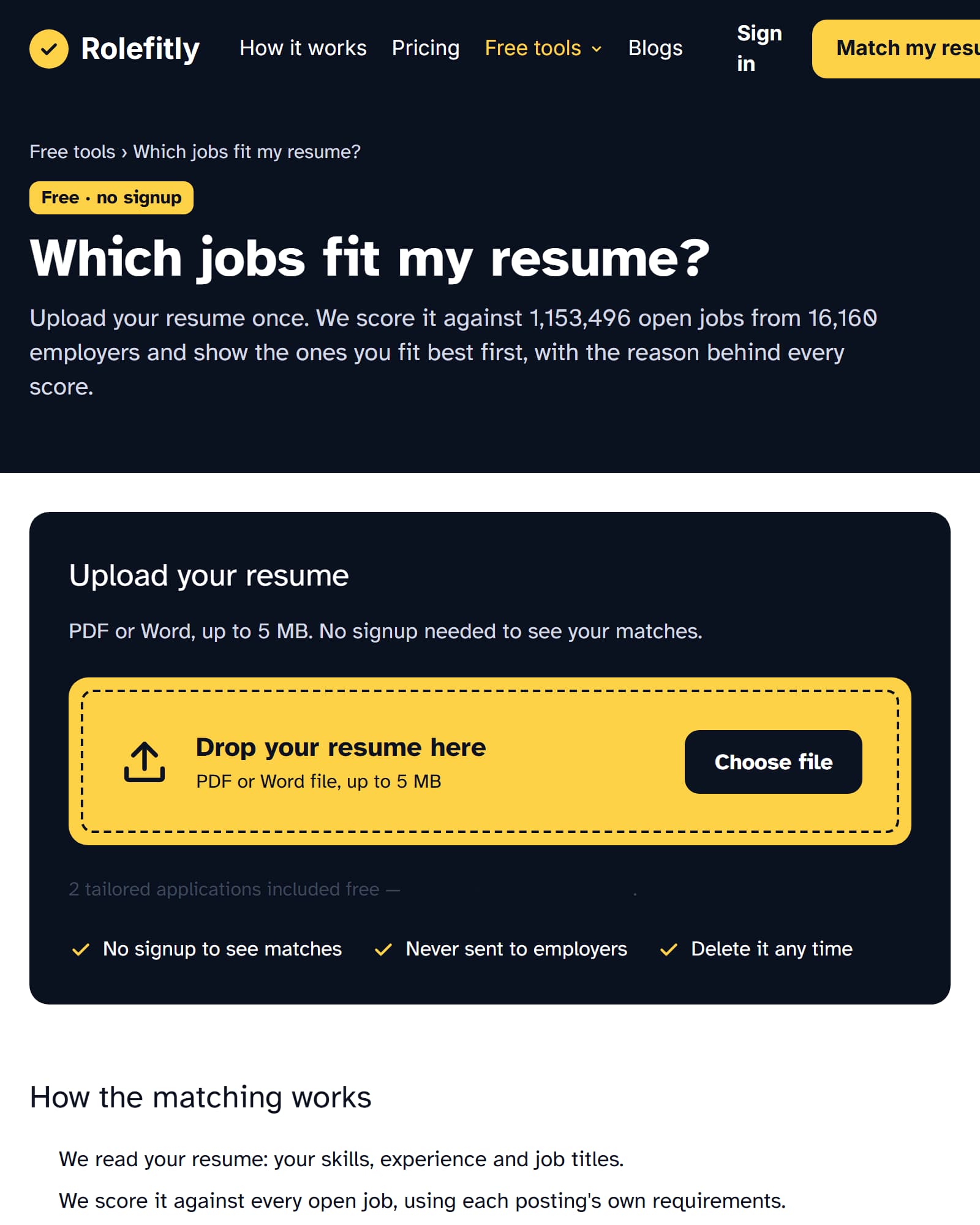
Rolefitly's free which jobs fit my resume tool, linked at the end of this post, does that sort. Upload your resume once and it scores you against open jobs from employers' own careers sites, best fits first. Jobs scoring under 50 are hidden by default, because they're rarely a realistic fit. Each score breaks down into skills, location, experience and job title, as explained on how matching works. A score estimates fit. It doesn't predict an interview. The free plan covers one resume check with your top 25 matches and their scores, weekly alerts and an application tracker. Rolefitly doesn't apply for you. You choose the jobs and apply on each employer's site.
If you're not sure which titles to aim at in the first place, start with how to find jobs that match your skills.